Profound is one of the platforms we use to measure how AI engines answer questions about our clients, so I read this announcement closely. Here is what the round says, what it doesn’t, and what an owner should do with it.
What did Profound announce?
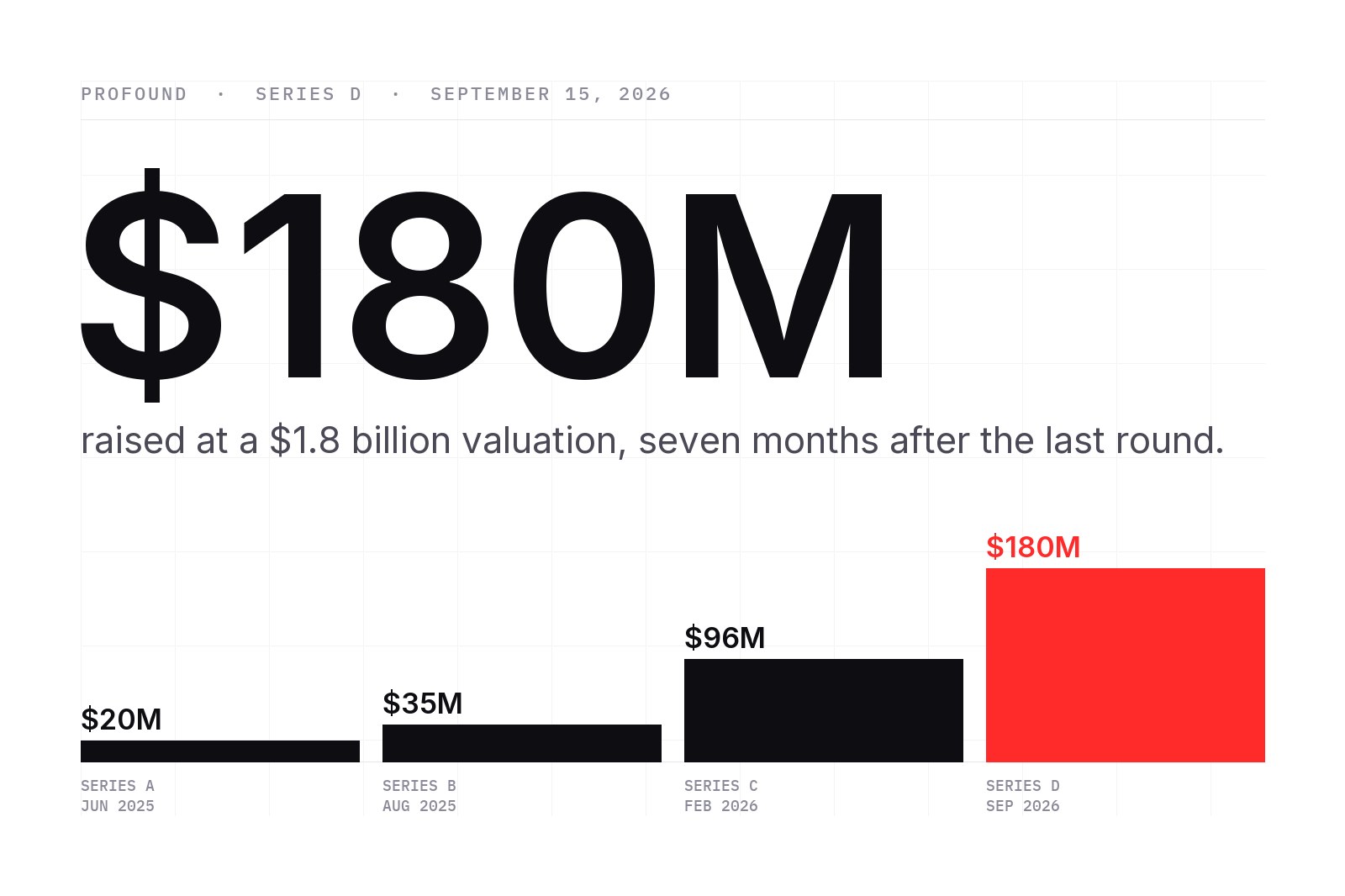
A $180 million Series D at a $1.8 billion valuation, co-led by Sequoia Capital and Kleiner Perkins, announced September 15, 2026.
Lightspeed Venture Partners, Khosla Ventures, Saga Ventures, Evantic and South Park Commons also took part. It is the company’s fourth priced round in fifteen months:
That is about $335 million raised in total by a New York company founded in 2024. The press release says Profound now serves more than 1,000 enterprise brands, including a third of the Fortune 100 and 16% of the Fortune 500. The named customers are the kind you would expect at that price: Walmart, Comcast, The Estée Lauder Companies, Royal Bank of Canada, Zoom, ServiceNow, Figma.
TechCrunch reported that revenue tripled in the six months before the round. The money goes to applied AI labs in New York and San Francisco and to a product called AI Marketer, which I will get to.
What does Profound actually do?
It asks ChatGPT, Gemini, Perplexity and the other engines the questions a brand’s customers ask, every day, and reports which companies get named and which web pages the answer was built from.
That is the whole product at its core. A marketer types in the questions that matter to the business (“best running shoe for flat feet,” “which bank has the best business checking account”). Profound runs those questions across the engines on a schedule. The dashboard shows who is mentioned, how often, in what light, and which pages the engine read on its way to the answer. Then it tells you what to publish to change the answer.
The new piece, AI Marketer, goes a step further. Instead of recommending content, it drafts and publishes it, in the brand’s voice, straight into the brand’s CMS. James Cadwallader, Profound’s co-founder and CEO, put the reason for that plainly in his announcement post: to answer a single question, an AI agent pulls from hundreds of pages. Being cited is a volume problem as much as a ranking problem. The engines want more pages that state more specific facts, and no marketing team has the hands to write them.
Why would investors pay $1.8 billion for that?
Because the place a buying decision gets made is moving, and the companies that measure the new place get paid first.
Rounds are priced on where the buyer is going, not on the product as it stands today. Four signals explain this one:
- Revenue tripled in six months, per TechCrunch. Enterprise marketing budgets are already moving.
- The same investors came back at nearly double the price. Kleiner led the Series A. Sequoia led the Series B. Both co-led this round at $1.8 billion, seven months after Lightspeed priced the company at $1 billion. Firms that already own a large stake do not re-up at that multiple on a hunch.
- Zero-click search hit 68% of U.S. Google searches in early 2026. I covered that number in Is SEO Dead? Most questions now get answered without a click, which means the answer itself is the battleground.
- Profound claims that on June 3, 2026, bot traffic passed human traffic on the web. That is a vendor’s number from a vendor with a reason to publish it, so treat it that way. But the direction matches everything else on this list.
A $1.8 billion valuation is a price tag on where the customer went.
Does any of this reach a business with one location?
Yes. The same engines that answer “which CRM should a bank buy” answer “best dry cleaner near Gramercy” and “who is the best real estate agent in Tribeca,” and they answer them the same way.
Profound’s customers are Fortune 500 companies because that is who can pay enterprise pricing. The mechanism does not care about company size. ChatGPT reads a handful of web pages, weighs which one states its facts most plainly, and names two or three businesses. For most local categories nobody has done the work yet, so the answer is being decided by whichever website happens to be legible to the engine.
We run the same class of measurement on the questions our clients’ customers ask: a homebuilder, real estate agents, a laundry, a bagel shop. For New York real estate we publish the results openly at Check The Scoreboard, fifty leaderboards of who the engines name, refreshed hourly. The pattern is the same at every size. The businesses that get named are the ones whose sites answer the question in a sentence an engine can lift.
So the gap for a smaller business is not the tool. A $1.8 billion company just confirmed where the customers went, and most owners’ websites still do not state their address, their hours, their prices, and what they are actually good at in plain words.
What should an owner do this month?
Three things, none of which need a platform.
- Ask the question yourself. Open ChatGPT. Type the sentence a customer would type, not the one you would. Note who gets named and which sites the answer links to. Do it once a week. That is Profound at zero dollars, for one question.
- Make your site legible. What you do, where, since when, for whom, at what price. One page per question customers actually ask, with the answer in the first paragraph. Engines quote specifics. They skip adjectives.
- Publish one specific thing. A single page that answers one question with facts only your business can claim: the year, the street, the number, the thing you did last week. One page like that beats ten pages of “welcome to.”
The bottom line
The Fortune 100 are now paying to be measured in AI answers. The rest of the market can be measured for far less, and most of it has not started.
$180 million says the shift from search results to answers is real enough for Sequoia and Kleiner Perkins to re-up seven months after their last check. Sell to a Fortune 500 or sell to the block, the engine is already answering the question your next customer is typing. The only variable is whether it can read you.
The engine does not know you are small. It knows whether it can read you.
Citations
- “Profound Raises $180M Series D at $1.8B Valuation to Build the AI Platform For Marketing Teams.” GlobeNewswire, 15 Sept. 2026. globenewswire.com
- “AEO startup Profound hits unicorn valuation, raises $180M Series D 7 months after last round.” TechCrunch, 15 Sept. 2026. techcrunch.com
- Cadwallader, James. “Profound has raised $180M to build the AI platform for marketing.” Profound, 16 Sept. 2026. tryprofound.com
- “Profound raises $96M Series C at $1B valuation to build the marketing platform for the AI era.” Profound, 24 Feb. 2026. tryprofound.com
- “Profound Raises $35M Series B as AI Search Becomes the Next Platform Shift.” PR Newswire, 12 Aug. 2025. prnewswire.com
- “Profound Raises $20M as Brands Race from Blue Links to AI Answers.” PR Newswire, 19 June 2025. prnewswire.com
- “Profound raises $180M to boost brands’ visibility in AI services.” SiliconANGLE, 15 Sept. 2026. siliconangle.com
- “Google zero-click searches reach 68% in early 2026: Study.” Search Engine Land, reporting SparkToro research using Similarweb clickstream data. searchengineland.com
What does ChatGPT say when someone asks for you?
A positioning audit runs the questions your customers actually ask across the engines and shows who gets named today, and what it would take to change the answer.
Book a consultation →