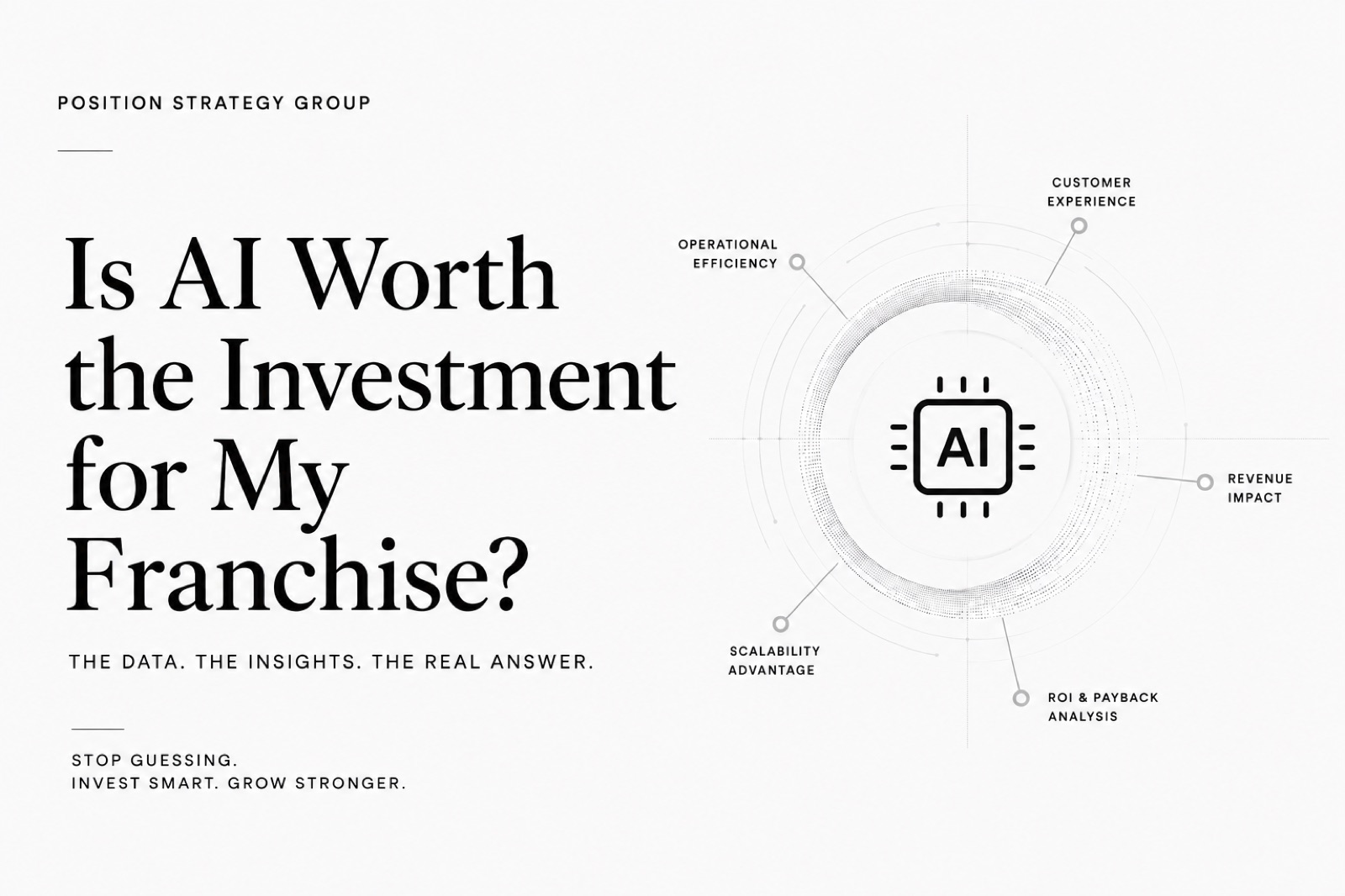
The data backs the “yes.”
Franchisee sentiment is strongly positive — one industry survey found that 87% of franchisees say more extensive use of AI tools would improve their marketing performance. Across industries generally, organizations that have scaled AI report meaningful savings: roughly 20% in operational costs and close to 30% in labor costs in the functions they automate.
The honest caveat is just as important. A meaningful share of franchisees who invest anyway see disappointing returns — almost always because they bought a platform before defining the problem it needed to solve.
What does AI actually cost for a franchise?
The range is wide enough that vague answers aren’t useful.
Entry-level AI solutions — a customer service chatbot, basic marketing automation, simple inventory prediction — typically run $50 to $1,000 per month per tool, with combined entry-level stacks landing in the $500–$5,000/month range. More comprehensive, custom-built platforms can run into the tens or even hundreds of thousands of dollars, but that tier is rarely where a single-location or small multi-unit franchise owner should start.
That spread matters because it means the “is it worth it” question isn’t really about whether you can afford AI at all — it’s about whether you’re being sold the right tier for your size. A tool priced and marketed around chain-level testimonials doesn’t automatically make sense for a one- or two-location operator.
A vendor who can’t produce a per-location ROI worksheet — not just a logo wall of big brands — is a signal to slow down, not speed up.
How do I know if a specific AI tool is actually worth it?
Three questions cut through most of the sales pitch. If a vendor can’t answer all three with specifics, that’s your answer.
- What’s the ROI math at my exact store size? A tool that saves two hours a week saves the same two hours whether you’re a 100-location chain or a single storefront — the dollar value of that time scales with your labor cost, not the vendor’s client list. Ask for a reference customer at your size and segment, not a chain-level case study.
- What’s the failure mode when the AI gets it wrong? Every AI tool makes mistakes sometimes. The ones worth paying for surface that uncertainty — a confidence flag, a “verify this” prompt — so you catch an error before it reaches a customer or a financial report. The ones not worth paying for fail silently, and you find out two weeks later when a number is already wrong.
- Does this replace a specific, named block of your time? Not “helps with marketing” in the abstract — does it replace the two hours you spend every week on scheduling, or the four hours on invoice reconciliation? If you can’t name the hour-block it replaces, you can’t measure whether it paid for itself.
Where does the ROI actually show up first?
Not in the flashy places.
The categories with the fastest, most consistently measurable return are the “boring” back-office ones: invoicing, payroll prep, compliance reporting, and royalty reconciliation — the invisible administrative tax every franchise location pays regardless of brand or industry. Automating that layer is the fastest, lowest-risk ROI available in the franchise stack, because it’s pure time savings with no customer-facing risk if something goes slightly wrong.
Customer-facing AI — chatbots, generative ordering, voice systems — gets more attention in vendor pitches, but it’s also where the “expensive theater” risk is highest. Some applications genuinely work well right now (AI as backup or overflow for inbound phone orders during peak hours, for instance). Others are being sold as production-ready when they’re not, and a franchise owner testing them should expect to pilot narrowly before trusting them with a customer interaction that matters.
What’s the realistic path to finding out if it’s worth it for me specifically?
Run an honest self-assessment before spending anything.
The questions worth asking your own operation, not a vendor:
- Do all your locations (if you have more than one) report core data — sales, traffic, reviews, labor — into one place, or is it scattered?
- Can you name, in hours and dollars, the specific administrative task costing you the most time right now?
- Do you have someone — even just yourself — willing to spend real, regular time over 60–90 days actually using one tool and tracking whether it worked?
If the honest answers are “no,” “not sure,” and “not really,” that’s not a reason to avoid AI — it’s a reason to start smaller and more deliberately than the sales pitch suggests. Launch one pilot, in the area with the clearest, most boring ROI, before touching anything customer-facing. Document a baseline before you start, and measure against that baseline, not against what the vendor promised.
The bottom line
AI is worth the investment for the large majority of franchise owners — but “AI” isn’t one investment decision, it’s dozens of smaller ones disguised as one big one.
The franchisees who see the cost and labor savings the data shows are possible are the ones who treated it that way: one tool, one measured problem, proof before expansion. The ones who get burned are almost always the ones who skipped that step and bought the platform first.
Citations
- “How AI is Shaping Franchise Marketing,” reporting the Constant Contact State of Franchise survey finding that 87% of franchisees say wider use of AI tools would improve their marketing performance. constantcontact.com
- Accenture and McKinsey Global Institute research on AI cost savings, commonly summarised as roughly 20% in operational costs and 30% in labor costs within automated functions. randgroup.com
- “The Complete Guide to AI Investment Costs for Franchises.” Franchise AiQ, 5 Feb. 2026. franchiseaiq.com
- “AI for Franchise Operators: What Actually Works in 2026 (And What’s Hype).” Avissh AI, 6 May 2026. avissh.com
- Ricci, Tommaso Maria. “AI for Franchises: The 2026 Playbook for Operators.” 25 Jun. 2026. tommasomariaricci.com
Not sure which problem to start with?
A consultation is free, and you leave knowing which single task in your operation is worth automating first — and what it’s costing you now.
Book a consultation →